The construction industry is highly competitive and constantly evolving. To succeed in this market, you need to showcase your work, establish trust, and attract new clients. That’s why having a well-designed construction website design is essential for your construction business. A good website can help you:
- Increase your visibility and reach
- Showcase your portfolio and services
- Build your brand and reputation
- Generate leads and conversions
- Communicate with your customers and partners
But how do you create a construction website design that stands out from the crowd and reflects your unique value proposition? In this article, we will share some tips and best practices for designing a stunning and effective construction website in 2024.
Use Colors That Reflect Your Brand
Color is a powerful tool for branding, so make sure the colors you use on your website reflect your brand identity and personality. According to a research, different colors can evoke different emotions and associations in your visitors, such as:
- Blue: Trust, professionalism, reliability
- Green: Nature, sustainability, growth
- Yellow: Energy, optimism, creativity
- Red: Passion, urgency, action
- Black: Elegance, sophistication, authority
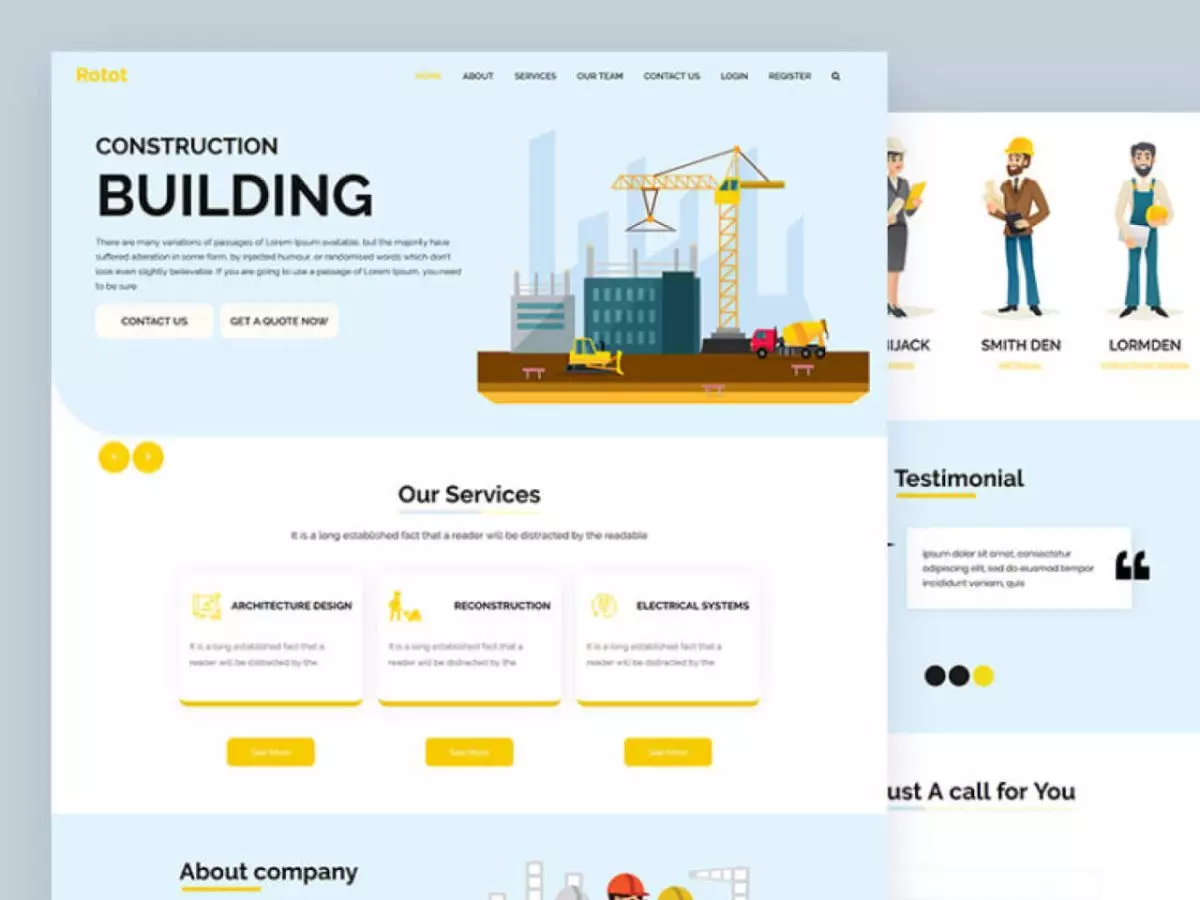
Choose colors that match your brand values and goals, and use them consistently throughout your website. For example, if you want to emphasize your eco-friendly approach, you can use green as your main color and complement it with earthy tones. If you want to highlight your innovation and quality, you can use blue as your dominant color and contrast it with yellow accents.
You can also use color to create contrast and hierarchy on your website, and draw attention to important elements, such as your logo, headlines, CTAs, and testimonials. For instance, you can use a dark background with light text for your header, and a light background with dark text for your body. This will create a clear distinction between different sections and make your website easier to read and navigate.
Use Video to Showcase Your Work
One of the best ways to showcase your work and impress your visitors is to use video on your website. Video can help you:
- Demonstrate your skills and expertise
- Highlight your past and current projects
- Show the process and outcomes of your work
- Tell your story and mission
- Engage and connect with your audience
According to a research, video can also boost your SEO and conversion rates, as it can increase your dwell time, click-through rate, and social shares. Therefore, you should consider adding video to your homepage, portfolio, about us, and testimonial pages.
You can use different types of videos on your website, such as:
- Background videos: These are videos that play automatically in the background of your website, without sound or controls. They can create a dynamic and immersive effect, and showcase your work in a subtle way. For example, you can use a background video of a construction site or a finished project on your homepage or portfolio page.
- Explainer videos: These are videos that explain your services, products, or processes in a clear and concise way. They can help you educate and inform your visitors, and persuade them to take action. For example, you can use an explainer video to introduce your company, your team, or your unique selling points on your about us or service page.
- Testimonial videos: These are videos that feature your satisfied customers or partners, who share their positive experiences and feedback about your work. They can help you build trust and credibility, and influence your visitors’ decisions. For example, you can use a testimonial video to showcase your successful projects, your customer satisfaction, or your awards and recognition on your testimonial or portfolio page.
Show Your Accreditations and Certifications
Another way to stand out from your competitors and establish trust with your visitors is to show your accreditations and certifications on your website. These are official recognitions or endorsements that prove your qualifications, standards, and compliance in the construction industry. They can help you:
- Demonstrate your professionalism and competence
- Enhance your reputation and authority
- Increase your credibility and legitimacy
- Attract more clients and partners
- Reduce risks and liabilities
Some of the common accreditations and certifications that you can display on your website are:
- ISO: International Organization for Standardization, which sets the global standards for quality, safety, and efficiency
- OSHA: Occupational Safety and Health Administration, which regulates the health and safety of workers and workplaces
- LEED: Leadership in Energy and Environmental Design, which certifies the sustainability and performance of buildings
- BBB: Better Business Bureau, which rates the trustworthiness and customer service of businesses
- NARI: National Association of the Remodeling Industry, which represents the professional remodeling contractors and provides education and certification
You can show your accreditations and certifications on your homepage, footer, or sidebar, and link them to the official websites or sources. You can also use logos, badges, or icons to make them more visible and appealing.
Use Social Proof
Social proof is the phenomenon in which people tend to follow the actions or opinions of others, especially when they are doubtful or unfamiliar. By using social proof on your website, you can:
- Influence your visitors’ behavior and choices
- Increase your trustworthiness and reliability
- Boost your social media presence and engagement
- Improve your conversion and retention rates
Some of the effective ways to use social proof on your website are:
- Testimonials: These are positive statements or reviews from your previous or current customers or partners, who express their satisfaction and appreciation for your work. You can display them on your homepage, portfolio, or testimonial page, and use photos, names, and titles to make them more authentic and personal.
- Case studies: These are detailed stories or reports that describe your work process and results for a specific project or client. You can showcase them on your portfolio or service page, and use data, images, and videos to make them more compelling and convincing.
- Social media: These are platforms where you can share your work, updates, and insights with your followers and fans, and interact with them. You can integrate your social media accounts on your website, and use widgets, buttons, or feeds to display your posts, likes, comments, and shares.
Use Interactive Features
Interactive features are elements that allow your visitors to interact with your website, such as:
- Forms: These are tools that enable your visitors to submit their information, queries, or feedback to you, such as contact forms, quote forms, or survey forms. You can use them to generate leads, collect data, or communicate with your visitors.
- Chatbots: These are software applications that simulate human conversations, and provide automated responses or assistance to your visitors, such as answering FAQs, booking appointments, or offering suggestions. You can use them to improve your customer service, increase your engagement, or optimize your conversions.
- Calculators: These are tools that enable your visitors to calculate or estimate various aspects of your work, such as costs, savings, or ROI. You can use them to provide value, educate, or persuade your visitors.
- Galleries: These are tools that enable your visitors to view your work in different ways, such as sliders, carousels, or lightboxes. You can use them to showcase your portfolio, highlight your features, or create a visual impact.
By using interactive features on your website, you can:
- Enhance your user experience and satisfaction
- Increase your user involvement and retention
- Encourage your user action and conversion
Make Sure Your Website is Search Engine Optimized
Search engine optimization (SEO) is the process of improving your website’s visibility and ranking on search engines, such as Google or Bing. By maximizing your website for SEO, you can:
- Increase your organic traffic and reach
- Target your ideal audience and keywords
- Outrank your competitors and gain an edge
- Measure your performance and results
Some of the essential SEO practices that you should implement on your website are:
- Use related and descriptive titles, headings, and meta tags
- Use keywords and synonyms strategically and naturally
- Use internal and external links to create a network of pages
- Use images and videos with alt text and captions
- Use responsive and fast-loading design for mobile devices
- Use analytics and tools to monitor and improve your SEO
Conclusion
You’ve just learned some of the best tips and practices to create a construction website design that stands out in 2024. Now you’re ready to take your construction business to the next level with a website that showcases your work, builds your brand, and grows your business. However, you don’t have to do it all on your own. You can work with ONextStudio, a web design agency that specializes in website design. Moreover, we also offer a range of services such as branding, and marketing design. Contact us today.